The next decade of biopharma R&D will be won by whoever redesigns the factory floor around AI
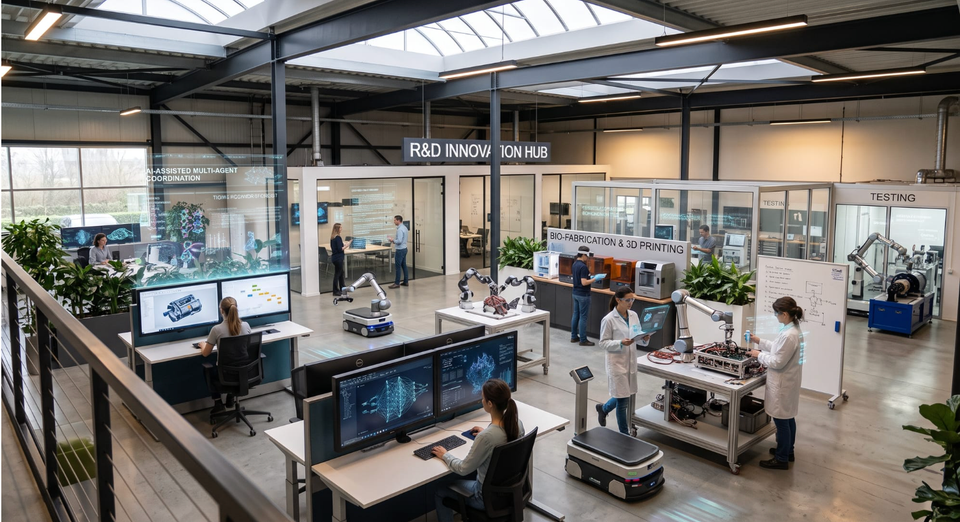
The thesis: R&D tooling is fragmenting faster than ever, which means scientific challenges are being solved area by area, piece by piece. What it leaves behind is an operational problem. The next decade belongs to whoever brings the external tech stack, their own data, their own models, and their own know-how into a single agentic system, and then redesigns research workflows around it.
The observation
R&D tooling is fragmenting faster than at any point in this industry's history. There are now 100s of vendors selling AI into pharma R&D — and that undercounts it, since it excludes foundation models, open-weight bio models, autonomous lab hardware, the internal platforms every large pharma is building, and the dozen tools a scientist already has open on their desktop.
Fragmentation is what a field looks like when its hard problems are decomposing into solvable ones. Structure prediction went from a grand challenge to an API call. Target identification, antibody design, literature synthesis, protocol generation — each is being handled by a specialist who does that one thing better than any generalist platform can.
None of this is expected to reverse. Venture is funding it at record levels, governments are funding it as part of national strategies, and the underlying problems have turned out to be tractable with AI, which was not obvious five years ago.
The part most people are underrating is what comes next. Connectors, MCP, and A2A let these AI tools talk to each other without giving up their IP or their revenue. A specialist can expose a capability without handing over its model or its data. This means scientific capability becomes something you assemble rather than something you build. What you own shifts, from the tools to the knowledge they produce.
So the science will increasingly solve itself. Not all of it and not evenly, but the trend line is unambiguous. Which means the constraint shifts elsewhere.
The new bottleneck is operational, not scientific
If science increasingly solves itself, the question shifts from which tool to buy to what your R&D should look like in five years.
Here is what I would argue for: one system holding four things at once. Two of those four you rent. The external stack — the specialists you will never build yourself — and the models everyone else has access to. Two you own, and only you: your proprietary data (the assays, the failed experiments, the decades of results nobody outside your walls has) and your institutional know-how (the workflows you've designed, how science actually gets done in your building). The rented pieces are table stakes. The owned pieces are the entire advantage. The system's job is to put them in the same place. Agentify all four together, then redesign research workflows around what that makes possible.
Nobody has this yet, because the pieces were never designed to fit. But now, it can all come together.
That is the opportunity, and it is an operations and systems-design problem rather than a science problem. It is also the only part of this that compounds.
We have run this experiment before
Electricity became commercially available in the 1880s. The productivity gains did not show up in the numbers until the 1920s. Forty years.
The delay was not technical. Factories in 1890 ran on group drive: one steam engine turning a central shaft, with leather belts running off it to every machine. Machine placement was dictated by proximity to the driveshaft, not by the sequence of work. When electricity arrived, most owners did the obvious thing — pulled the steam engine, bolted in a large electric motor, kept the shafts and belts. New power source, same factory. The gains were marginal.
The unlock came a generation later with the unit drive — a small motor on each machine. Once every machine carried its own power, the driveshaft was unnecessary, and the floor could be laid out around the flow of work. That is when you get assembly lines and the productivity explosion. Paul David made the argument in The Dynamo and the Computer in 1990.
The value was never in the motor. It was in the redesign that the motor made possible.
Most AI deployment in biopharma R&D today is group-driven. We bolt a model onto a process designed around the constraints of a pre-AI organization: same stage gates, same handoffs, same review committees, same assumption that a literature review takes three weeks because a human has to read the papers. The tool gets faster, the workflow does not change, you get 10–20%, it stalls, and people conclude AI was overhyped.
Which points to two moves, in order. First, agentify research, give agents real access to the tools, the data, and the institutional context, and let them do the work rather than summarize it. That is the motor: necessary, now largely a solved engineering problem, and worth incremental gains.
Second, redesign the workflow around what agents make cheap. This is where the 10x lives, and almost nobody has started. If literature synthesis costs minutes instead of weeks, why does target selection still run on a quarterly cycle? If an agent can design, cost, and pre-register a hundred experiment variants overnight, what is a portfolio review committee for? If a good experiment gets an order of magnitude cheaper, the right number of experiments is not last year's number.
These are org-design questions, not model questions. R&D leadership answers them, or nobody does.
We see what venture is funding as a clear signal
The sharpest signal is not the pharma AI partnership announcements. It is the capital going into biotechs that are trying to look like a new pharma.
Xaira launched with $1B in a single round and no prior financing — the largest debut in the sector's history — to build discovery around AI from scratch. Lila Sciences raised $550M for autonomous labs. Isomorphic Labs has now raised in the billions. Six more AI-first companies launched straight out of stealth with single rounds above $67M and nothing before them. Anthropic is building a new biopharma with 1/100 of the workforce, and Formation Bio has raised over $600M, not with better science but with a thesis that biopharma is just doing it wrong.
None of these was funded on a molecule. They were funded on an operating model. The bet behind a billion-dollar check to a company with no pipeline is not that the founders will be able to understand biology faster and better than a conventional large biopharma company does — it is that a company assembled from scratch around AI can put the pieces together better than an incumbent can: no legacy stack, no committee structure, no thirty years of process to unwind.
That is a bet against the biopharma operating model, not against science.
The next decade of R&D advantage will not go to whoever has the best model. Everyone will have the best model. Not everyone has thirty years of failed experiments and the workflows that produced them. It will go to whoever redesigns the factory floor around what they alone own.