Company Before Co-Founders
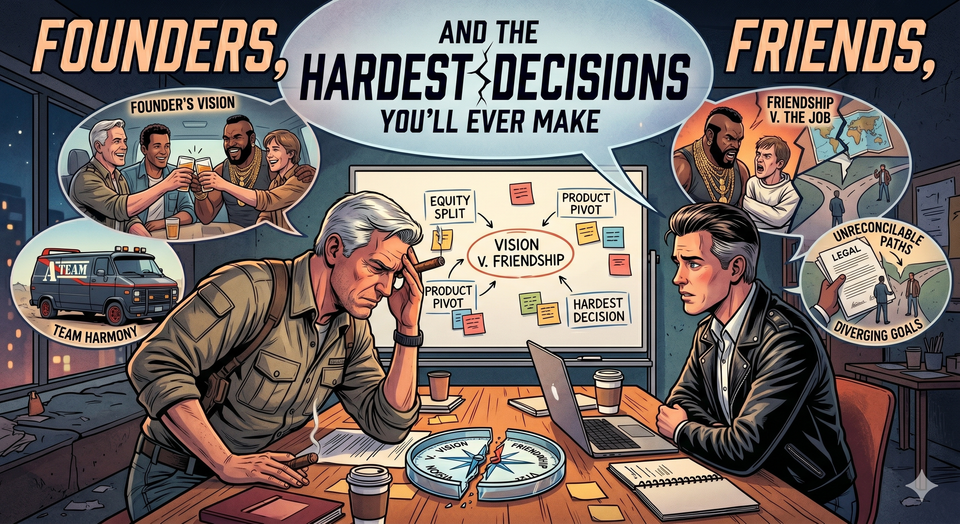
I was as pale as a person can be. My wife took one look at me when I walked in and asked if I was okay. I told her I thought I had a stomach virus. I ran upstairs and threw up.
I didn't have a virus. I had a panic attack.
Earlier that day, in my very first meeting with a new board investor, they told me one of my co-founders needed to be moved out of their C-level role. And I had no idea how to do it. This was someone I'd built the company with. Someone I respected. And I was being told, calmly, that the org had outgrown them.
I've started three companies. I've built with my closest friend, with people I'd never met before, with founding teams as small as two and as large as five. I've made almost every mistake you can make with co-founders — and had to live with the wreckage of each one.
Here's the thing: almost no one writes about honestly. Not how to find a co-founder — there are a thousand posts about that. What happens when the relationship breaks, shifts, or has to end? If your company outlives its first year, this is the thing that will make or break it. And the founders who survive it are the ones who thought about it before it got hard.
Everything below comes down to one idea I learned the expensive way: your co-founder is not your company. Your commitment is to the thing you're building, not to any single person building it — including yourself.
Lesson one: Implement founder vesting. No exceptions.
My first time out, I started two companies at once with my best friend. Truly my best friend in the world. We did what almost everyone does — went to a lawyer, incorporated, split equity roughly 50/50. Our lawyers gave us exactly one piece of advice I ignored completely: implement founder vesting.
Founder vesting means your equity vests over time, usually four years. You don't own it all on day one. If a founder leaves after a year, they don't walk away with the same stake as the one who grinds for the next decade.
I thought: we're best friends, we trust each other, we don't need this.
About six months in, my friend hit serious family issues. He came to me and said he couldn't work full-time anymore — maybe two or three hours a day on the finances. I cared about him far more than I cared about the abstract idea of "the company" in that moment. So I said yes.
The result: I worked full-time. He worked a few hours a day. We owned the same percentage. The company didn't make it. We sold it mostly to recover the investment.
The lesson was clean, and it hurt. You have to do what's right for the company, not what feels emotionally easier in the moment. That is brutally hard when your co-founder is also the person you love most outside your family. Structure is what protects you from your own good intentions.
Four-year schedule, one-year cliff. Do it even — especially — when it feels unnecessary. The moment it feels unnecessary is exactly the moment you'll be glad it's there.
Lesson two: When no one else will say it, you have to.
I was determined not to repeat the mistake. We set up the legal structures properly. We vested. Five founders, and over time, I became CEO.
One of them — I'll call him X — had become a genuine friend as we built. But something shifted. The work stopped exciting him. His engagement didn't just dip, it fell off a shelf, and everyone could see it.
The other founders came to me privately, one by one, to vent their frustration. Not one of them wanted to say it to his face. Nobody wanted to be the bad guy.
I'd just read The Hard Thing About Hard Things for the first time. One line reshaped how I think about the job: as CEO, your primary commitment is to the company. Not to any individual. Not to your own comfort. It's a fiduciary duty, and it doesn't pause because the person across the table is your friend.
So I set up a roundtable with all five of us, X included. I opened it up and invited everyone to say what they'd been telling me for weeks.
Silence.
Every strong opinion, every bit of frustration — gone. The people who'd cornered me in hallways wouldn't meet my eyes. I was sitting there holding a grenade that everyone else had handed me and then quietly backed away from.
I had a choice. Retreat, blame the awkwardness, kick it down the road. Or do my actual job.
I put it all on the table. I said out loud what everyone had told me privately. I told X his level of engagement couldn't continue — commit fully and change how he was operating, or leave. He chose to leave. It got personal. I was the only bad guy in the room.
It was one of the hardest things I'd done in my career to that point. And it taught me something that has nothing to do with being liked: the willingness to say the unsaid thing is the job. If you wait for consensus in the room, you'll wait forever. The privately furious go quiet the second there's a face attached to the cost.
One more thing came out of it. Clean up exits legally, in real time. When a founder leaves, get proper releases at the moment of departure — not whatever vague language sits in your incorporation docs. Future investors will crawl your cap table. Loose ends and ambiguous exits always resurface, always at the worst time.
Lesson three: Move faster than feels comfortable.
Which brings me back to the panic attack.
Same company, later phase. Over 100 people. New investor on the board, first meeting, and they tell me a co-founder needs to move out of their C-level seat. That's the day I went home and threw up.
What followed was months of avoidance, then months of slow, honest conversations. And what I found surprised me. The founder didn't even want the big leadership role. They wanted to be deep in R&D — solving hard technical problems, not running a large org. When I finally had the direct conversation, they were almost relieved.
We moved them into a senior R&D-focused individual contributor role. It fit. It freed us to hire a leader built for that scale. Over the next six to twelve months, they decided they didn't want to stay for the long haul either, and we parted on good terms.
The outcome was fine. The process was a disaster.
I stretched a four-month decision into more than a year. Prolonged ambiguity is the cruelest option, not the kind one. The person in the wrong seat knows. Their team knows. Delaying doesn't protect anyone — it just spreads the pain across more people and more months.
If lesson two is about the courage to say it, this is about the speed to act on it. They're different failures. I've made both. The second one feels like patience and generosity while you're doing it. It isn't. Move faster — not ruthlessly, honestly. Assume the person across from you is an adult who can handle a real conversation. More often than not, they already feel the misalignment too and are waiting for you to name it.
Lesson four: Revesting aligns incentives with the actual journey.
If the company works, it isn't a two-year project. It might be a decade or more. That length creates a problem most founding teams never see coming: revesting.
Here's the trap. You've raised your B. A few years have passed. Most founders have vested a big chunk of their equity — half or more. From that point, a founder can walk with an enormous stake while the hardest, most value-creating work is still ahead of everyone who stays.
The pattern I believe in: after a real milestone like a B round, take whatever equity is still unvested and reset it to vest over a fresh four-year period.
This isn't about squeezing founders. It's about telling the truth. The company's biggest work may be in front of it, not behind it. Incentives should point at the future you're asking people to build, not the years they've already banked. Revesting protects the company, aligns the team with the next chapter, and signals that everyone's still in it.
Lesson five: Being a founder is not a trump card.
Not everyone who starts a company is built to be an executive at scale. Companies ignore this truth for years, and it quietly drags on growth and culture the whole time.
Around 100 people at BenchSci, we started seeing clear mismatches. Some founders were extraordinary innovators — commitment off the charts, judgment sharp. But managing teams, running processes, and carrying organizational overhead didn't match their strengths or their interests.
So we made a deliberate move. Some founders shifted from leading teams to being senior individual contributors — think internal fellows. No reports. Instead, they owned the hardest, most forward-looking problems in the company. Their impact stayed enormous. The way they created it changed.
To do this, you have to take on ego head-on, including your own. Most founders tie their sense of worth to a title, a team size, a box on the org chart. The story in their head is: I'm a founder, I should be a VP, I should have reports. At a certain scale, that story stops being true.
Call it the founder trump card — the belief that starting the company entitles you to run a function forever. After a certain point, measured in years, headcount, or rounds, founder status should stop winning organizational arguments. People belong where they add the most value going forward, not where their ego is most comfortable.
That includes the CEO. It includes me.
Before you need any of this
Here's what I'd hand my past self, taped to the wall on day one:
Implement vesting from the start — four years, one-year cliff, no "we're friends" exceptions. Plan for revesting after major milestones. Treat founder exits as normal, not as failures. Clean up every exit legally, in real time. Talk about the "divorce" before you need to — ask, up front, what happens if one of us outgrows the other. Decouple ego from role, starting with your own. And move faster on the hard conversations, because they never get easier by waiting.
Companies rarely die from one bad product call or a single wrong hire. They die because the people at the core can't or won't navigate these transitions — and every one of them runs straight through a friendship.
You may throw up sometimes. You may lose sleep. You may lose friends.
But if you want to build something that lasts, you have to have the conversations, make the decisions, and put the company first. Your co-founder is not your company. Neither are you.
That's the real hard thing about the hard things.